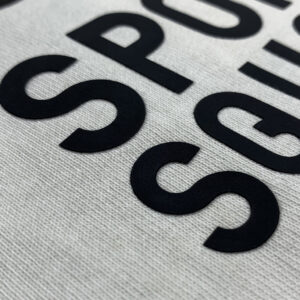

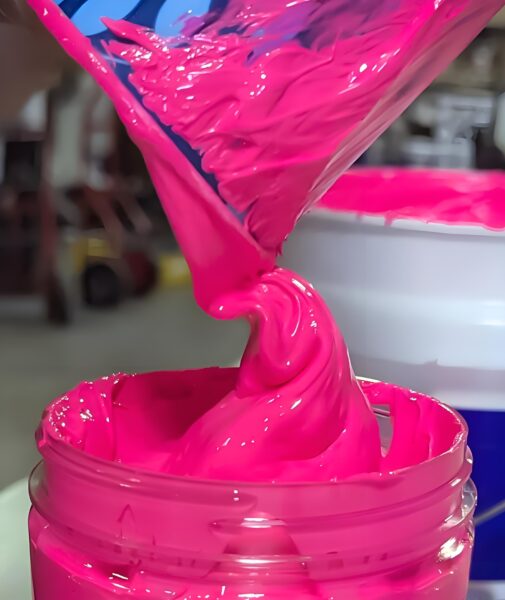
Introducing 蓄光ピンク Screen Printing Plastisol Ink楽しく鮮やかなこのインクは、独自の二色効果で人々の注目を集めます。日中は明るく大胆なピンク色に輝き、夜になると柔らかなピンク色の光を放つ幻想的な光景へと変化します。デザインに魔法のようなタッチを加えたいスクリーン印刷業者に最適なこのインクは、昼夜を問わず、印刷物を際立たせます。
Key Features:
- 輝くピンクの光光に当たるとエネルギーを蓄え、暗闇で柔らかなピンク色の光を放つインクです。その発光効果は魅力的で、薄暗い場所や真っ暗な場所でもデザインがはっきりと見えるため、イベントウェア、子供服、特別なプロモーションなどに最適です。
- 日光の下では鮮やかなピンク色発光していない状態では、インクは明るく鮮やかなピンク色を呈し、幅広い用途に適しています。鮮やかな昼間の色は、様々な種類の生地上でも豊かで不透明さを保ち、照明の有無に関わらず、プリントの見栄えを格段に向上させます。
- Smooth Application蓄光ピンクプラスチゾルインクは、滑らかでクリーミーな質感で、スクリーン全体に均一に塗布できます。細かいディテールも鮮明に再現し、広い面積もムラなくカバーします。インクはスムーズに伸び、シャープでプロフェッショナルな仕上がりのプリントを実現します。
- Long-Lasting Glowこのインクは、光を当てると長時間発光効果が持続します。夜間イベント用グッズ、ノベルティグッズ、販促用衣料など、用途を問わず、数時間発光し続けるため、印象的な視覚体験を提供します。
- 洗濯に強く耐久性があるプラスチゾルを配合したこのインクは、優れた耐久性を誇り、洗濯を繰り返しても鮮やかなピンク色と光沢を保ちます。色あせ、ひび割れ、剥がれにも強く、デザインが損なわれることなく鮮やかなまま残るため、使用頻度の高い衣類に最適です。

Benefits:
- 目を引くデザイン鮮やかなピンク色の発色効果を持つこのインクは、インタラクティブ性と驚きをデザインにプラスし、より魅力的なものにします。他にはないユニークなものを提供したいブランドやイベントに最適で、暗闇で光る機能により、印刷物は忘れられない印象を残します。
- 多用途このインクは、ファッションアイテムやパーティーウェアから販促グッズまで、様々な用途に最適です。ナイトイベント、フェスティバル、子供服など、どんな場面でも、その発光効果は楽しく遊び心のある魅力を生み出し、あらゆる年齢層の顧客を惹きつけます。
- 視認性の向上ファッション性だけでなく、ピンク色の光沢は実用的な価値ももたらします。ベストやジャケットなどの安全装備に使用すれば、スタイルを損なうことなく、暗い場所での視認性を向上させることができます。
- 様々な生地に対応可能蓄光ピンクのプラスチゾルインクは、綿、ポリエステル、混紡素材に使用できるため、スクリーン印刷業者はこの汎用性の高いインクを幅広い衣料品や販促品に使用できます。その柔軟性により、作品に美しさと機能性の両方を加えたい印刷業者にとって最適な選択肢となっています。
Recommended Use:
- Best Fabrics蓄光ピンクインクは、綿、ポリエステル、および混紡生地に効果的で、これらの素材全体に滑らかな密着性と均一な発光効果をもたらします。
- Mesh Count Recommendationsメッシュ数110~156は、インクの定着と発光強度の最適なバランスを実現します。これにより、昼間は鮮やかな発色、暗闇では印象的な発光効果が得られます。
- Curing and Cleanupインクの鮮やかさと光沢の持続性を確保するには、160℃(320°F)での硬化が必要です。スクリーンは一般的なプラスチゾル洗浄液で簡単に洗浄できるため、効率的で手間のかからない作業が可能です。
Creative Applications:
- ナイトイベント用アパレルTシャツからパーカー、アクセサリーまで、このインクはイベントグッズに最適です。発光要素を加えることで、イベント全体の体験をより一層引き立てることができます。コンサート、フェスティバル、テーマナイトなどに最適で、暗闇の中でもデザインがはっきりと見え、魅力的な印象を与えます。
- スタイリッシュな安全装備夜間の視認性が不可欠なベスト、ジャケット、自転車アクセサリーなどの安全装備に、遊び心をプラスしましょう。発光効果により、実用的な視認性を確保しながら、スタイリッシュで魅力的な外観を維持します。
- 斬新なデザインと子供服子供服、パジャマ、コスチュームなどの楽しいデザインに最適です。蓄光機能が遊び心とワクワク感をプラスします。鮮やかなピンク色の光は子供たちを喜ばせ、就寝時間やイベントをより楽しいものにしてくれるでしょう。
With 蓄光ピンクスクリーン印刷用プラスチゾルインクこのインクを使えば、あなたのデザインは色彩と創造性で輝きを放ちます。ファッション、機能性、あるいは遊び心など、どんな用途でも、このインクは独自の二重効果を発揮し、あらゆるプリントを際立たせます。使いやすく、耐久性があり、視覚的にも美しいこのインクは、スクリーン印刷プロジェクトに明るく輝くアクセントを加えるのに最適です。

Demand communication
1. You first need to clarify your specific requirements for Plastisol Ink, including expectations in terms of color, gloss, viscosity, durability, etc.
2. Communicate with the ink supplier or custom manufacturer and elaborate on your application scenario, such as whether it is used for printing textiles, paper or other materials. Different application scenarios may require inks with different characteristics.
→Contact Us
Samples provided
1. The supplier or manufacturer will prepare some preliminary Plastisol Ink samples based on the requirements you provide.
2. You test and evaluate the samples to check color accuracy, printing effect, drying time, adhesion to the substrate, etc.
→Contact Us
Adjust and Confirm
1. If you are not satisfied with the sample, please communicate with the supplier in time and put forward specific suggestions for adjustment.
2. The supplier will adjust the ink formula according to your feedback and provide samples for your confirmation again.
3. After repeated adjustments and confirmations, you will be completely satisfied with the performance and quality of Plastisol Ink.
→Contact Us
Signing a contract
1. Once the final ink formula and quality standards are determined, both parties need to sign a custom contract.
2. The contract should clearly state the ink specifications, quantity, price, delivery time, quality assurance and other terms.
→Contact Us
Production & Delivery
1. The supplier produces Plastisol Ink in accordance with the contract requirements.
2. During the production process, quality inspections may be carried out to ensure that the ink meets the standards agreed by both parties.
3. The customized Plastisol Ink will be delivered to you on time, and relevant quality inspection reports and instructions for use will be provided.
→Contact Us
After-sales service
1. If you encounter any problems during use, you can always contact the supplier for technical support.
2. The supplier may make further optimizations and improvements based on your feedback to improve the quality and performance of the product.
→Contact Us
Plastisol Ink Production Process
Plastisol Ink After-Sales Support
Our after-sales support is one of the cornerstones of our business model. We are fully committed to providing first-class after-sales service to ensure your satisfaction.
Through our comprehensive after-sales support, we aim to sell you our products and build a lasting relationship based on trust and satisfaction. We are here to support you and ensure you get the most out of your investment in our Plastisol Inks.
Technical consultation and guidance
If you encounter any problems when using Plastisol Ink, such as poor printing results, abnormal ink performance, etc., the supplier's technical team can provide you with professional consultation and guidance.
Training
For customers who use Plastisol Ink for the first time, the supplier may provide training on how to use it. The training content includes the correct method of mixing ink, operating skills of printing equipment, and precautions for printing process.
Product optimization and improvement
According to customer feedback and market demand, suppliers will continue to optimize and improve Plastisol Ink, for example, improving the environmental performance of ink, enhancing color stability, and improving the rheology of ink.
Customer complaint handling
If a customer is not satisfied with Plastisol Ink's after-sales service or has other complaints about the product, the supplier will have a dedicated customer service team to handle it.
Frequently Asked Questions about Plastisol Inks
Plastisol Ink is suitable for a variety of fabrics, including 100% cotton, cotton/poly blends, polyester, dark and light colored fabrics, denim, etc. However, please note that it may not be suitable for some special fabrics, such as plastic, metal, glass, etc. and waterproof nylon fabrics. The reason why it can be used on these common fabrics is that these fabrics can withstand high temperatures of 150°C to 180°C and are breathable, allowing the ink to penetrate. For example, on pure cotton fabrics, Plastisol Ink can produce clear, bright and long-lasting prints; on polyester-cotton blends, it can also adhere and color well.
There may be many reasons why Plastisol Ink has poor fastness during operation. First, it may be that the ink is not properly selected, has poor compatibility with the printing material, or the ink has expired and has become ineffective. For example, ink that is not suitable for a specific fabric material is used, or ink that has been stored for too long and has degraded performance is used. Secondly, the ink layer is too thin and the adhesive is damaged, which can also lead to poor fastness. This may be due to improper adjustment of the viscosity of the ink during printing, or errors in the operation process. In addition, insufficient heating and slow printing drying speed will also affect the fastness. If the heat and air supply are insufficient, the ink cannot be fully cured and it is difficult to achieve the desired fastness. In addition, when overprinting, the lower layer of ink is not completely dry and is covered by the new ink layer, forming a false dry, which will also affect the fastness. In addition, dirt on the surface of the printing material, too thick a printing ink layer, too much ink, too high a viscosity, which causes the ink to become brittle after a long drying period, and the tension of the printing material surface is lower than the tension of the ink, etc., may all lead to poor fastness of Plastisol Ink.
The storage of Plastisol Ink requires the following conditions. Generally speaking, it should be placed in a cool, dry place away from direct sunlight and high temperature environments. The storage temperature should not be too high or too low to prevent changes in the ink’s performance. During storage, ensure that the container is well sealed to prevent the ink from coming into contact with the air, and to prevent moisture and impurities in the air from entering the ink and affecting its quality. For example, if the ink is exposed to the air for a long time, the solvent in it may evaporate, causing the ink to thicken or even dry, affecting the use effect. At the same time, the ink should be used according to its shelf life. Expired ink may have problems such as performance degradation and poor curing.
The printing process of Plastisol Ink is relatively complicated. First of all, the selection of screen is very important. Generally, 100-120 mesh thick plate is selected. Use a screen printing hard square knife to scrape at 75 degrees, and use transparent ink to prime 1-2 times. When printing for the first time, scrape 4-6 times with force. For color ink, print 2-3 times (or directly print color ink 3-4 times without primer). After printing, heat treatment is carried out, and it is baked at 150-180 degrees for 1-3 minutes. During the printing process, the ink layer needs to be blown to dry with a hot air gun before each reprint to prevent it from sticking to the screen. For example, when printing a pattern with a three-dimensional effect, it is necessary to control the thickness of the ink and the strength of the scraping to achieve the ideal three-dimensional effect.
Plastisol Ink has many effects and characteristics. First, it is paste-like and thixotropic. It is thicker when left standing, and becomes thinner when stirred. The temperature affects the viscosity. In summer, the viscosity is low and the ink is thinner, while in winter, it is the opposite. Second, it can print a variety of special effects, such as pulping, pulping and hot stamping, toothbrush particles, rounded corners, right angles, brown color, gel, sticky beads, hot stamping, stone, non-slip, bark, etc. It is suitable for manual printing and mechanical printing of textile fabrics, leather, denim, shoes, etc. Third, it will not dry at room temperature. It needs to be heated to 150°C – 180°C and baked for 1 – 3 minutes to completely solidify the ink. After plasticization, the adhesion firmness is above level 5 for wet washing and above level 4 for dry rubbing. Fourth, it can be combined with various textile decorative auxiliary materials such as glass beads, plastic beads, plastic sheets, metal glitter sheets, light reflective materials, etc. for special effect printing, which is low cost and completely environmentally friendly. For example, in clothing printing, Plastisol Ink can be used to print patterns with three-dimensional effects and rich colors, increasing the beauty and uniqueness of clothing.
Cause analysis:
One of the main reasons is that the thermosetting ink is not fully baked. If the baking temperature is not high enough or the baking time is insufficient, the ink cannot be fully cured, which will cause the slurry layer to lack elasticity and even appear powdery.
The quality problem of the ink itself may also cause this situation. For example, the improper proportion of resin components in the ink and the failure of additives may affect the curing effect and elasticity of the ink.
During use, if the ink is over-diluted, the slurry layer may also lose elasticity and appear powdery. Excessive dilution will destroy the composition ratio of the ink and reduce its performance.
Solution:
Ensure the correct baking temperature and time. According to the instructions for use of the ink, adjust the temperature and time of the baking equipment so that the ink can be fully cured. Generally speaking, increasing the baking temperature or extending the baking time can improve this situation.
Check the quality of the ink. If you suspect that there is a problem with the quality of the ink, you can contact the supplier for testing or replacement.
Avoid over-diluting the ink. When using diluent, strictly follow the proportion to ensure the performance of the ink.
Cause analysis:
One of the common reasons is that the ink layer is heated to a temperature of more than 230℃. Excessive temperature will change the composition of the ink and produce gas, which will cause the ink layer to bubble.
Adding solvent diluents to the ink may also cause bubbling. Solvent diluents may react with the components in the ink to produce bubbles.
Adding other water-based substances to the ink may also cause bubbling. Water-based substances are incompatible with oil-based inks and are prone to chemical reactions to produce bubbles.
Solution:
Control the baking temperature. Make sure that the heating temperature of the ink layer is within the appropriate range, generally not exceeding 230℃. A thermometer or temperature control equipment can be used to monitor and adjust the baking temperature.
Use a special diluent for thermosetting inks instead. Avoid using solvent diluents and choose a special diluent suitable for thermosetting inks to reduce the risk of bubbling.
Do not add water-based substances. When using thermosetting inks, make sure that water-based substances are not mixed in to avoid adverse reactions.
Cause analysis:
The surface of the slurry layer is not completely dry, which is one of the main reasons. If the baking time is insufficient or the temperature is not high enough, the surface of the slurry layer may not be completely dry, and anti-sticking may occur.
Adding too much diluent may also cause surface anti-sticking. Too much diluent will slow down the drying speed of the ink and increase the possibility of surface anti-sticking.
Slurry that is too thin may also cause surface anti-sticking. Too thin slurry will affect the curing effect of the ink and make the surface prone to anti-sticking.
Solution:
Appropriately increase the baking temperature or extend the baking time on the original basis to ensure that the surface of the slurry layer is completely dry. You can judge whether it is dry by observing the color change of the ink layer and touching the dryness of the surface.
Control the amount of diluent. According to the instructions for use of the ink, reasonably control the amount of diluent added, generally not more than 8%.
The thickening powder specially used for heat-curing ink can be used to increase the consistency of the ink. Properly increasing the consistency of the ink can improve its curing effect and reduce the situation of surface anti-sticking.
Plastisol Ink Cleaning and Maintenance
The following are the cleaning and maintenance methods for Plastisol Ink:
1. Cleaning
Printing equipment cleaning
After each use of Plastisol Ink, the printing equipment should be cleaned immediately to prevent the ink from drying on the equipment and affecting the next use. For screen printing machines, special screen cleaning agents or thinners can be used to clean the ink from the screen, scraper, ink pad and other parts.
When cleaning the screen, you can first use a soft brush to gently brush off most of the ink on the screen, then spray it with a cleaning agent, and finally rinse it with clean water and dry it. Be careful not to scratch the screen with a hard brush or sharp objects to avoid damaging the mesh.
The scraper and ink pad can be wiped with a wet cloth dipped in a cleaning agent to remove the remaining ink. For some difficult-to-clean parts, tools such as toothpicks or fine needles can be used to assist in cleaning.
Cleaning the workplace
Clean up the ink stains around the workplace in a timely manner to prevent the ink from polluting the environment. You can use a rag or mop dipped in a cleaning agent to wipe and mop the floor.
Ink dripping on the ground should be cleaned as soon as possible to avoid it being difficult to remove after drying. You can sprinkle some sawdust or sand first, absorb the ink and then clean it.
2. Maintenance
Ink storage
Plastisol Ink should be stored in a cool, dry, well-ventilated place, away from direct sunlight and high temperature environment. The storage temperature is generally between 5℃ and 30℃.
The ink container should be well sealed to prevent air from entering and causing the ink to dry or deteriorate. During storage, the state of the ink should be checked regularly, and any abnormalities should be handled in time.
Equipment maintenance
Perform regular maintenance on printing equipment to ensure the normal operation of the equipment. For example, check the wear of the scraper and replace the severely worn scraper in time; check the tension of the screen and adjust it in time if it is loose.
Lubricate the transmission parts, guide rails, etc. of the equipment to reduce wear and extend the service life of the equipment.
Safety precautions
During cleaning and maintenance, appropriate protective equipment such as gloves, masks, goggles, etc. should be worn to avoid ink contact with the skin and respiratory tract.
Cleaning agents and diluents are generally volatile and flammable, and should be kept away from fire and heat sources and used in a well-ventilated environment.
関連商品
-
Specialty Inks
Glow In The Dark Yellow Plastisol Ink
-
Specialty Inks
Glow In The Dark Orange Plastisol Ink
-
Gold Silkscreen Ink
Glitter Plastisol Ink
-
Specialty Inks
Foil Plastisol Ink